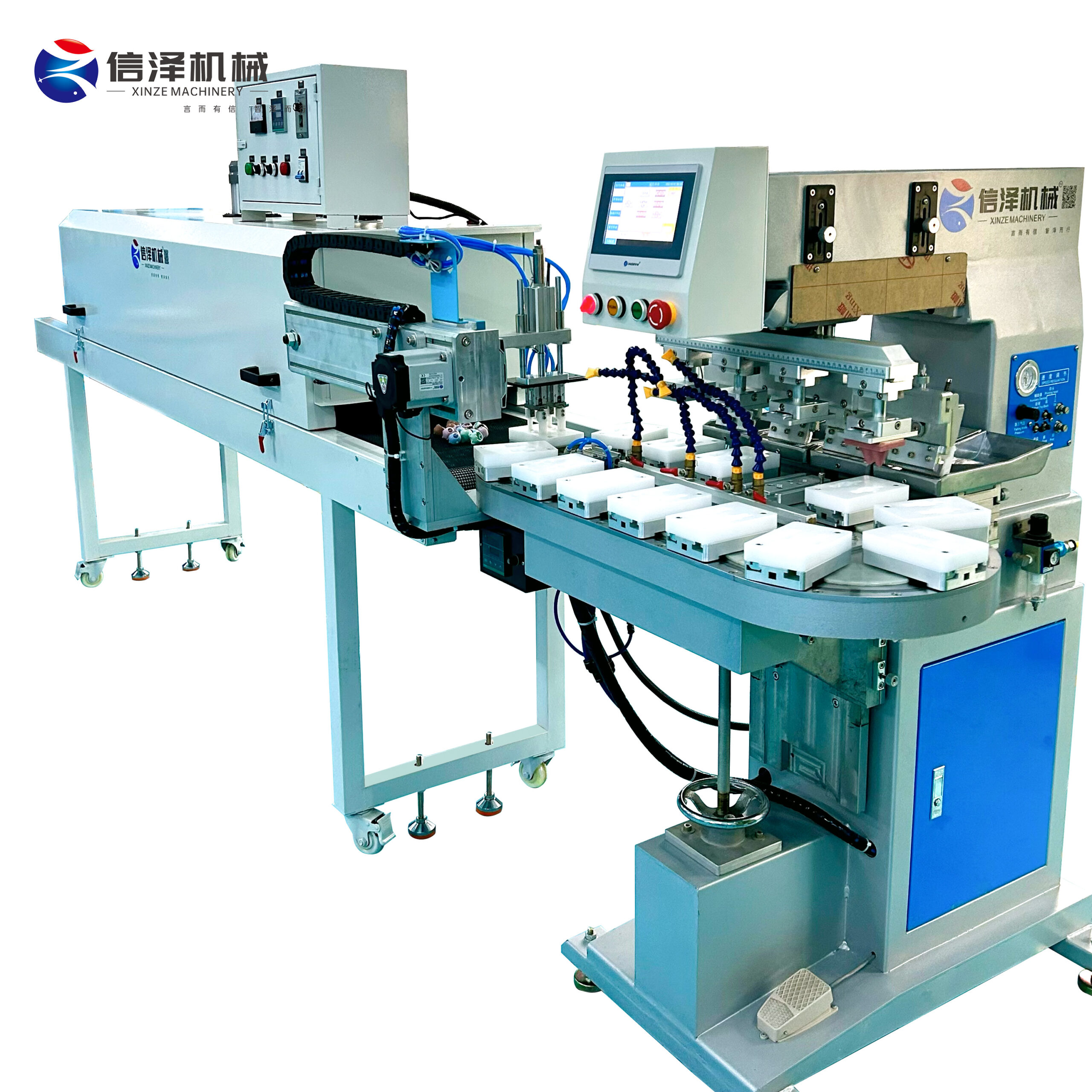
In today’s competitive branding and packaging industry, producing vibrant, multi-color logos consistently is a significant challenge. Manufacturers often struggle with registration errors, slow manual throughput, or rising labor costs when printing on complex substrates such as promotional cups, cosmetic containers, or industrial components.
A 4 color pad printing machine directly addresses these production bottlenecks by combining automated precision with flexible mechanics—making it an essential asset for businesses aiming to improve print quality while controlling overhead.
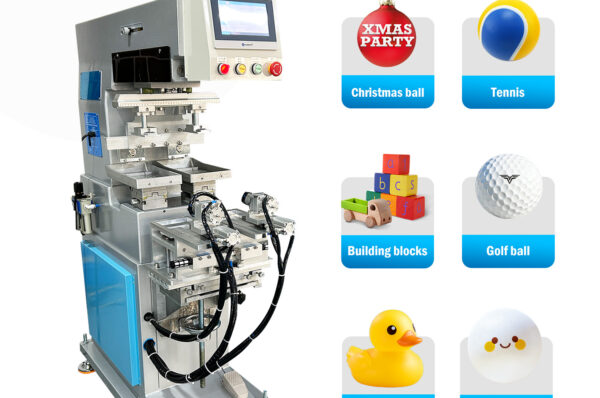
Sinzer’s high-precision semi-automatic pad printer (Model XZ-PM2-150) bridges this gap. Whether your project involves printing on plastic, metal, glass, or ceramics, this servo-driven solution streamlines multi-color workflows and eliminates the frustrations of outdated printing equipment.
Manual vs Fully Automatic vs Semi-Automatic Printing
When evaluating multi-color printing setups, manufacturers often consider three tiers of solutions:
Limitations of Manual Systems
Manual pad printers rely entirely on the operator’s skill to align colors. This leads to:
- Slow production speeds
- High alignment scrap rates
- Material waste during test runs
Trade-offs of Fully Automated Systems
Fully automatic machines deliver high throughput but come with drawbacks:
- Large factory footprint requirements
- High upfront investment
- Long setup times, especially for small-to-medium batch variations
Semi-Automatic Advantage: Sinzer XZ-PM2-150
Sinzer’s semi-automatic system combines manual loading with robotic unloading, reducing labor fatigue while maintaining perfect registration via a high-precision servo system. It is ideal for agile, high-mix, low-volume production.
Core Features That Solve Real Printing Bottlenecks
Sinzer’s 4 color pad printing machine isn’t just a collection of parts—each feature is designed to solve practical production challenges:
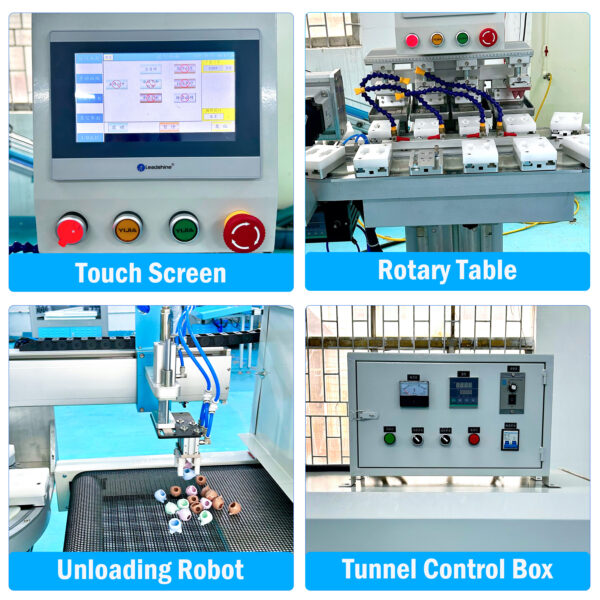
High-Precision Servo-Driven Motion
- Guarantees millimeter-level registration accuracy across all four colors
- Reduces misalignment and material waste
- Maintains consistent speed for reliable output
Robotic Unloading Integration
- Manual loading allows visual inspection of complex curved objects
- Robotic arm automatically unloads, reducing repetitive tasks
- Improves overall cycle time and allows one operator to manage the station
Comprehensive Substrate & Connectivity Ecosystem
- Material Compatibility: ABS, Plastic, Stainless Steel, Glas, Ceramics, Metal
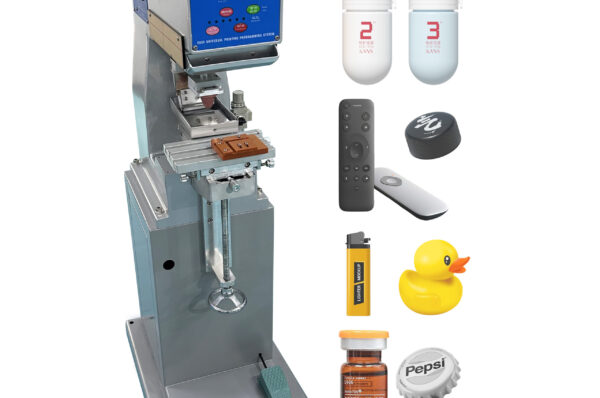
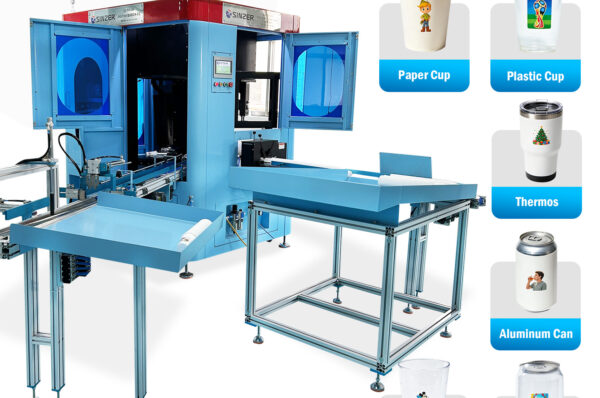
- Industry Applications: Beverage cups, cosmetic jars, toys, safety helmets, promotional pens
- Connectivity: Bluetooth, NFC, Wi-Fi, USB, Ethernet
- Safety & Support: CE certified, 1-year warranty, 24/7 technische ondersteuning
Real-World Production Scenarios
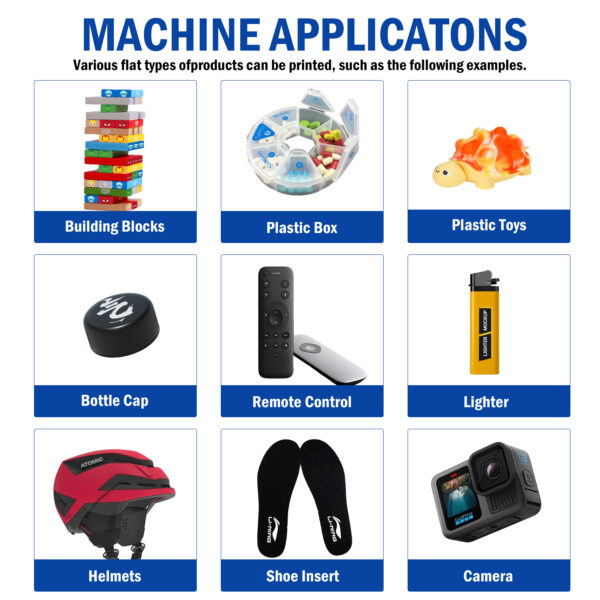
Where does a 4 color pad printer deliver the fastest ROI?
- Promotional Merchandise Branding: Print complex, multi-color corporate logos on pens, lighters, power banks, and plastic promotional items with minimal setup time.
- Industrial & Electronic Components: Handle small-batch tracking codes, safety indicators, and branding directly on rugged plastic enclosures or stainless steel hardware.
- Custom Consumer Packaging: Print seasonal graphics onto beverage cups, food jars, and cosmetic containers without needing massive batch sizes.
By addressing registration errors, labor costs, and workflow inefficiencies, Sinzer machines allow manufacturers to produce high-quality prints quickly and efficiently.
Key Considerations Before Purchasing
Before committing to a 4 color pad printing machine, review these operational criteria:
- Substrate Geometry: Ideal for curved, irregular, or indented surfaces; match ink type to substrate surface tension
- Factory Air & Power: Confirm pneumatic pressure and electrical voltage meet machine requirements
- Turnkey Support: Sinzer provides custom fixture drawings within 3 dagen, full engineering proposals in 7 dagen, and structured on-site or remote training
Equipment Feature Matrix
| Feature | Manual Printer | Volledig automatisch | Sinzer XZ-PM2-150 |
|---|---|---|---|
| Registration Precision | Moderate (Operator Dependent) | High | High (Servo-Driven) |
| Labor Requirement | High (Skilled) | Low | Low-to-Moderate (Robotic Unload) |
| Factory Footprint | Small | Large | Compact / Cell Friendly |
| Batch Flexibility | High | Low | Excellent (Fast Plate Swaps) |
| Upfront Cost | Low | High | Moderate (Optimal ROI) |
Veelgestelde vragen
Q1: Can the machine print fewer colors if needed?
Yes. The XZ-PM2-150 is fully programmable for 1, 2, 3, or 4-color cycles depending on your batch.
Vraag 2: Why is a servo motor superior to pneumatic shifting?
Pneumatic systems fluctuate with air pressure, causing microscopic alignment shifts. Servo motors use precise digital encoders to maintain exact pad positioning every cycle.
Q3: Which inks are needed for glass or metal?
Non-porous surfaces like glass or stainless steel typically require solvent-based two-component (2K) inks with a hardener. Sinzer’s team provides recommendations for ink type and pad durometer during the proposal stage.
Conclusion
Investing in a Sinzer 4 color pad printing machine is a strategic move for manufacturers seeking precision, efficiency, and versatility. Its semi-automatic operation, servo-driven accuracy, and broad material compatibility deliver an affordable, future-proof solution for modern workshops.
Ready to automate your branding and eliminate alignment errors? Explore Sinzer’s Advanced Pad Printer Series or contact our technical sales team today for a custom 7-day engineering proposal.